Friday, 24 June 2016

'Brexit' - An internal perspective

The UK has voted in favour of leaving the EU. Well, this is what's being discussed in the UK this morning accompanied by both champagne and tears.
As an engineer, my conclusion would be that the result is very unclear; the UK is either unsure or divided.
I think the truth is that we are both. However, the vote has fallen on the side of "Leave".
Why?
Well there are many reasons. I strongly believe that the UK belongs within the European Union, but I hope I can help my international colleagues understand why UK citizens would vote "out".
Here are some reasons..

Hearts & Minds

The campaigns leading up to the vote have been characterised by fear. Both sides argued that "the world will end" if we voted the other way. A nationalist minority, headed by the UK Independence [political] Party ("UKIP"), managed to link EU membership with immigration in the minds of voters. This was a vote of the heart as much as (if not more than) the mind. In the end, this is more of an emotional result than a cognitive one.

Austerity & Inequality

There is a great deal of dissatisfaction in the UK. The government since 2010 has been implementing austerity policies which have served to exaggerate inequality which was already rising. Many people feel unhappy with the UK's direction but do not have a clear idea why. The referendum offers a big decision which is essentially a choice of keeping something as it is, or doing something different; a vote to leave is a vote for change.

Left Right Left Right

UK politics has recently swung towards the right. Whereas over the last century, the left side of politics has been seen to represent the "workers" and the right side the rich. The left have recently lost the trust and identification of lower income voters. Now there is a broad consensus with right-wing philosophy; the UK has subscribed to neo-liberalism; a faith in the free-market and a distrust of government. The EU has an important role in regulating business in the name of society, however UK society has broadly thrown itself at the feet of business, so suddenly the EU seems counterproductive.

The Voice of the Media

Some very popular newspapers have been pro-leave. These have used sensationalist headlines and images to reinforce misconceptions and fears around Europe. A great deal of information used to promote leaving has been inaccurate and misleading, while the remain campaign has largely limited itself to use well supported information. Despite most UK leaders being in favour of remaining in the EU, the media has had a louder voice than our leaders

The British Empire

Britain's history probably plays a part in this vote. When Brits look into their history for identity, they see the British Empire. Despite the fact that this is firmly in the past, with British imperial colonies now independent, and the industrial strength which powered the empire's formation now spent, for many it represents our identity. There is a feeling that Britain is naturally in charge. Despite the facts, there is a sense that Britain can "go it alone" and be a strong world leader if we are completely independent, just like the "good old days".


I was going to write a short section on "What Next?" But the truth is I don't know. We should treat this result with some regard, it tells us something important about the currents flowing under the UK surface.
In the meantime, please treat us kindly, I hope to post again soon.

Monday, 28 April 2014

The Leader with a Thousand Faces

I'd like to take a walk through the topic of leadership.  Let's start with where we are; the world we see around us..

Generally speaking, our model of leadership is built on the basic principle of the leader on top.  It makes sense, after all we live in a world where power and authority are centred with the strong and capable.  Leadership as a role is a mixing pot of influence, headship, coordination, facilitation, direction and decision.

So how do we unpick this?  What is really happening, and can we imagine a form of leadership that is truly free from the paradigm of power and control?

To try to pick apart some of these many tangled functions, let's consider leadership in a leaderless environment.  Many systems and communities are entirely self organising.  Complexity theory, which represents many entities we see in nature, describes utterly flat organisations with extremely high levels of inter-connectedness.  To get a picture of this, consider a flock of birds, a shoal of fish, or maybe a colony of ants, termites or bees.  There is no centre of coordination, yet the system is undoubtedly capable of sophisticated and intelligent collective behaviour.  How is it done?

Mathematics has shown that even simple rules followed by members of a large connected population can deliver remarkably sophisticated results (see the example of cellular automata).  But there's more, individuals can and do wield their influence on the entire community; the first one to detect a threat and change direction triggers a shift in the whole system.  Behaviour of an individual can create a pattern that ripples through the whole collective.  In fact, in a super-connected system it is hard for an individual action not to have system-wide consequences, even if they are seemingly short-lived or insignificant.

So from this first case, let's start building some archetypes of leadership.  Because leadership isn't a role or a position, it's a set of functions, it belongs in the realm of process, dynamism and change, not structure, permanence or sustenance.  An archetype of leadership, as I would like to put it, describes a transition, a trigger, a genuine change in the probable outcome.  So here's my first nomination:  First to Move.  We see it in stories and films, often when the challenge has been laid before a group.  Step up and do right, or keep the status quo.  Once one moves, the rest will likely follow, but if they don't, the one that moved first will pay the price.  In attempting to take the safety-in-numbers onto a new path, the First to Move has to momentarily risk everything and forego that safety.  The First to Move takes a risk, prepares to make a sacrifice, and then hopes that the character of the whole will step up to the character of the individual.

Organic systems may offer us a glimpse of another archetype.  The human brain has certain centres of communication, hubs if you like.  Points that are connected to all the low-level distributed regions and act as motorways of communication.  High speed regional centres that speed up contact between separated points.  Via these hubs, any part can communicate with any other part quickly without having to be able to manage all of those communication paths directly.  In social networks certain people are nodes highly connected within a community and crucially to other nodes outside it too.  There is no doubt that the architecture of connection is vitally important, but more on that later.  For now, I nominate another archetype:  Connector.  The connector, in their very being, acts as the key link to makes things happen.  They look highly social and involved, not necessarily the originator of any behaviour but the conductor of huge amounts of valuable information from all around the system that facilitate its spread.

This is interesting because the Connector has broken the homogeneity of the system, but not the connectedness.  As long as the Connectors are effective, all parts of the system can still see all others.  This shouldn't be confused with the all-too-familiar role of the single-point-of-contact, which effectively (intentionally or unintentionally) filters information.  In organic systems there are multiple channels of communication; connectors serve to speed one of these up, not restrict the flow.  And here we already start to touch upon a very human aspect to leadership.  We are not just elements of the system, we are its architects.  Unlike any other creature, we create, design, build and manipulate communities and connections.  We are the plants and we are the gardeners.  So some of these archetypes of leadership are architects.  But before we go there, I would like to suggest one more archetype that operates from within.

Complex systems have this characteristic that processes and patterns expressed at the micro level are repeated at many levels above; as you zoom out, the same shapes keep reappearing at larger and larger scales.  In maths we call patterns like this fractals.  I like the example of a snowflake.  Snowflakes, as we know, take many different forms but they often follow an amazing and complex six-fold symmetry.  They are not designed, but each of the arms forms under the same conditions and most crucially, from the same tine nucleating crystal at their origin.  So my next suggestion is the Nucleation Point.  Some small point that exhibits certain new behaviour that then replicates and initiates now properties that propagate through the system.  This poignant behaviour gets replicated at different levels and is the starting point for defining characteristics of the whole.
A honeybee performing his dance is a nucleation point, his information on the location of food sources gets cascaded through the system, influences the behaviour of others and can eventually affect the relationship of the whole colony with its surrounding geography.  He could even set the flavour of the honey.

But now let's move onto the architecture question.  Because it's here that I want to really get down to where I think leadership has become broken, and it links back to how humans are broken in the first place.  Let's assume for a moment that humans are "meant" to operate as part of a near-infinitely connected system.  Closely, elaborately and dependently connected to all other humans and the Earth which sustains and homes us.  If this is the case, then we can form the ultimate self-organising complex communal system.  If our primary identity is that of the collective; "I am nature" then the high-level needs and aims of all parts of the system are harmonised.  Of course, we see around us a world of competition and selection, a world which doesn't fit with the ideal of this structure, but humans with all their brains and technology could help to neutralise and recreate this order as they went.  All they would need is to stay in a state of deep, far reaching interdependence with each other and the world.  It would sort itself out, all would aim for the overall surviving and thriving of the whole order.

Now we all know that's not how it works.  But why?  Well for a start none of us likes the idea of "far reaching interdependence", in fact we pretty much aspire to the opposite; self-sufficient independence, but that doesn't make for a vey healthy system.  For a moment, let's take a step back and look at this from the perspective of a cold and calculated network system engineer.  Now my nodes don't want to be connected to each other any more.  They still need information to make decisions and understand the world around them, so what can be done?  Well, you could replace some of the connections with the equivalent of a fixed value, or better, some fixed rule- some kind of stimulus-response that is defined and repeatable and doesn't depend on lots of inter-connectedness to give feedback.  Great, now I've replaced a connection to the complex, turbulent deep and dark ether with what is effectively a well built wall.  Nothing passes through but I can lean on it, bounce balls of it and get on with life happy and secure.  You could even cut off whole sections of the network with this kind of separation.  Back to reality then, if we're thinking about groups of people, what would this look like?  It's all to familiar, it's The System, it's organigrams, it's laws, rules, manners, bureaucracy, guidelines, procedures.  It is the stuff of leadership and management in our world.  All of these are substitutes for being able to see the whole picture and choose the best response.  Sometimes we do it for lack of trust, sometimes for lack of visibility - we just can't see enough, but it always impedes the natural self-organising power of the community.  As such, we can loose our complex strengths; adaptability, responsiveness, efficiency and agility.  We become a machine and the leaders are the engineers.

But I'm not interested in that.  It is well known and well documented and it probably doesn't need another blog about it.  We're looking at leadership as gardeners, not engineers.

So what archetypes of leadership exist at the architectural level?  Just before we go there, let's look at an odd archetype of leadership that semi-transcends the contained system.  This is actually one of the archetypes of the mono-myth, identified by Joseph Campbell.   It is the Herald.  One who calls the people to a new direction; who delivers the decisive catalyst for engagement.  This is an important function, one of commissioning and mandating the community to take on new priorities and make sacrifices.  Here's the really interesting thing; it has to come from the fringes, from the borderlands, the outlying boundaries of the system.  A good Herald must have enough stake in the community to be credible, to have the best motives, but unless the call comes somehow from without, it lacks the spark, the authority, the authenticity to provoke change.  "This can't just come from within us" says the community, it must have something extra, something original.  Here's where I think this gets really interesting, because it suggests that it is actually fundamentally impossible for one person to simultaneously carry out all leadership functions.  You cannot be simultaneously in the middle (to be a Connector or Nucleation Point) and the edge (to be a Herald).  And perhaps this is where Government (despite it's habitual dependency on systems and boundaries as its instruments of leadership) really has it wrong.  Political leaders try to do it all and therefore often fail across the board.  Their calls for change lack authenticity, energy and originality.  Their efforts to nucleate are undermined by their obvious heraldic agenda.  Finally, an essentially legislative entity cannot be a connector - a wall-builder doesn't produce bridges.  But politics isn't where this is post is trying to go.  So on to the final question, how to garden?

Here's where I get excited, disappointed and then excited again.  When you try to garden, you think about the soil, the distribution of different plants and the weather.  Perhaps this is all a bit soft.  Leaders think about who they have where, how they are connected and how they can be facilitated, strengthened and coordinated.  A gardening leader ends up making connections (planting Connectors), sowing seeds (creating Nucleation Points) and sometimes delivering the call (Heralding), although it's often best to find a Herald from somewhere else (obviously!).  It's hard to plant the First to Move, they really must come from within.  And this points to my disappointing realisation; sometimes you can't plant or grow what's needed.  You simply have to be it.  So here's my overarching archetype for the leader; to be The Seed.  Eventually, the leader has to become integrated into the community they lead.  They have to be invested.  A seed has to fall to ever germinate.  And this is where I finally get excited.  because I think that deep down, most of us are actually attracted to the risk of committing ourselves completely, investing wholeheartedly and seeing what we can grow into if we embrace interdependence, let go of control and be.

Sunday, 7 October 2012

Expectations

I suppose that the question of expectations has been the one at the heart of my thinking for a while. I've been avoiding it for this very reason. If I can't answer this, I'm still stuck.

What should we expect? This is the realm of the cheesy pseudo-deep non-answer; "the unknown", "the unexpected", "the improbable", "the impossible". But the question deserves better. As much as life shapes our expectations and our experience of the world, we are powerful and meaningful beings; our expectations shape it back, and all along we shape ourselves. So it is fundamental.

And as much as what is, is - what we allow ourself to see is governed by our filters of expectation. What is possible may be limited, but our expectations limit us further, and there's a risk (and a prevailing reality) that we make the possible impossible by refusing it.

So what should we expect? What can we allow ourselves to expect? What dare we expect? Great and marvellous things happen, so do disasters. It seems that we can't expect something into being, but surely expectations cannot only function to be limiting; able to close doors but never open them?

I think it comes to a question of normality. Expectations need a frame of reference- are we aiming high or low? What do we have a right to expect? Maybe this is crucial.

But maybe we're getting the whole idea of expectation wrong in the first place.

After all, every expectation lives in a world view. We expect things; stuff, or events. Our expectations are structured from material conditions that can be satisfied or disappointed in fixed moments or periods of time. But, as we know all too well, these things are always riddled with unknowns and doubts. Yet God is against fear, and the most crippling fear is born of doubt. It seems that God expects confidence, but in what?

How should we handle our expectations? Not in events or objects, achievements or possessions it would seem. God doesn't seem to have a consistent policy in dishing out lifestyle outcomes, yet He insists that we can all expect His presence in our life experience.

Maybe we shouldn't be expecting things, but processes.

Actions and events have consequences. In the particular outworking of events or stories we cannot be sure, but God seems to be fixed on consequences. What we do matters. Our actions, decisions and relationships reverberate through lives and generations. This is the realm of deep causality, ruled by process, not event. And we understand it, this is the domain of the story, the growing seed, cycles of death and life and continuities of reality. In the end, we can't plan the future, but as humans, we can plant it.

Seeds sown will germinate, God has set the conditions for growth. And here, in the realm of process, we start to see some prevailing certainty. Good fruit proceeds from good trees, and vice versa, but with a bias. The universe, says God, is a weighted die. The ripples of the good outlast the ripples of the bad. There is a prevailing wind.. We live in a time of paradox, two worlds share the same substrate, a war is won but the battles go on. We are in the chase scene just before the end, and you just can't tell who's winning.

But back to the expectations of process. How do we set our expectation? I suppose, we look a little deeper for the ripples.. We expect a cause, and expect a purpose. Expect that someone's behind something, that if it feels significant, it is.

And here's where we get our power back. We cannot command our world, but we can shape it, a speaker I heard recently said it well, cultivation instead of domination.

To live out the story of nurturing people and the world like it will yield a harvest to us, to our will, is a model of love, of life, and, I think, our expectations. We cannot control, nor predict what will come, but this we can expect; that our response will affect it. We live for the long game, we trust in the bigger process.

In the space of a moment, everything is a discernible object. If you could press pause on the world, and observe it over an infinitely short moment, even a candle flame would look like a fixed, inanimate object. Yet not one atom, nor one Joule stays the same in a burning flame, it is a process, like the waves on the sea. Look over a longer period and you can see it; nothing stays the same, and "objects" are simply the momentary state of the substrate through which the processes ripple and flow. Over millennia, even forests are botanic oceans, a continuous process of growth, death and regrowth. No single cell remains, but a forest of pine will be a forest of pine, and oak, oak. In the end, over all of time, it all comes down to process.

To live in this reality, and have the expectations of process, changes our view of the present. Of course the state of the moment matters, but what we trust in is not what it will look like, but how it will get there. Here, God really gets His hands dirty; watch how Jesus tackles the process, the chain, and then the condition. God breaks the constraints of the ripples of our past then declares freedom. Where He less often changes objects, He extravagantly breaks and makes connections and consequences left, right and centre. God, it seems, is the Maestro of the process. In these matters, deep truths of story and humanity are our instruments, God is the architect and the world is our garden once again.

Friday, 13 April 2012

Fatherhood

Last night, as a I enjoyed the company of a few of my comrades, someone asked "What's the biggest challenge of being a father?"

For me, the biggest challenge is supporting a mother.  Don't get me wrong, I know that bringing up a child is a massive task, so please don't think I'm underestimating or under-rating it.  Also please don't read anything about my wife out of this statement!!  No, the point is that I can love a child as a father; give them cuddles, protect them, play with them, listen to them, lots of things.  But how do you look after a mother?  Some loads are hard to lift- I'm out most of the day during the week, and I don't have the equipment needed to feed, and to some extent comfort, babies when they're young.  I can support, facilitate, encourage and be present and available.  But it often feels weak and insufficient.  For me, this is the biggest challenge.

We also discussed more direct matters to do with interacting with our children.  How we communicate, how we handle and express our emotions. 

We also realised that, as fathers, we form part of our children's image of God.

That got us thinking.

The challenge is two-fold.

One:  We are commissioned to show our children the type of unconditional, ever patient, ever believing, ever freeing, ever empowering, ever hoping love that God has for us.

Two:  What we do end up demonstrating can be a bridge or a barrier to our children realising God's character and interacting with Him consciously in their lives.

That was a bit heavy.

We talked about "society", and how our young generations really need to have more contact with adult men as positive influences and models.

The thing that struck me the most, though, was that we had the conversation at all.

Here's the challenge.  To engage with the real stuff- not concepts and ideas.  The reality of plain regular daily grind recognising that what we do, and the little interactions, matter in some kind of transcendent way.

Difficult mess is our medium.  Let's talk about it.

Saturday, 24 March 2012

Reality

So here's some thoughts on reality;

We each have our own little world in our head.  We make sense of the world around us through a kind of story that identifies us, and in which we try to place every new experience to help us orientate ourselves with the world.  The story is constantly adjusted and reassessed, especially when new experiences don't fit the old story.  It gets updated and we carry on using it.  In this story are our failures and fears, but also our triumphs and expectations.  Popular culture would tell us that it's ok that everyone's little worlds are different.  Each is equally valuable and valid.  Each one is true to us, which is true enough.  Furthermore, we are not entitled to tell anyone else that their little world is wrong, especially if ours also happens to be right (which of course it is).

The problem is that this isn't the case.  There's one reality.  One world, one history, one Earth.  We can't all be right, and this is our experience, but it hurts.  Isn't it interesting that we get really stressed when our expectations aren't met, however unrealistic they may have been.  When human beings with a non-functioning or paralysed limb can see it but not control it, they experience physical pain.  People who are blind often find that sounds around them become "noise" when they can't mentally assign them a source - thinks that don't make sense to us frustrate and upset us.  The point is that when people get their world-view wrong, it causes pain, first to themselves, but often soon after to those around them.  These discontinuities confuse us and introduce doubt and fear.  Fear imprisons us, and we live half-lives filled with empty expectations, self doubt and general unease.

To be free, we need to live in reality
Realistic expectations don't breed disappointment.  Sometimes we see this, and we see the freedom.  Think of it like "living in the moment".  It comes like simultaneously holding life lightly and embracing it enthusiastically.

Here's the next thing, there's more to reality than we see if we just look on the surface.  To make my point, here's some physics as an analogy (stay with me here)..

Sound (yep; noise, music, voices etc) is simply ripples of vibration in the air.  The average position of tiny air molecules vibrates back and forth, transmitting the vibration onto the others around it.  You can measure it, you could set up a microphone, and draw a trace of these vibrations over time.  To be honest, it wouldn't look that great.  In fact, it would pretty much look completely random most of the time.  You could tell when the sound was loud or quiet by looking at the amplitude, or height, of the peaks and troughs, but that's about it.  In fact, when people like engineers, scientists or music producers look at sound, they don't normally look at the vibration over time.  Instead, they look at frequency.  Frequency is how many times the vibration happens in a given period of time.  A frequency of 50 Hz means fifty full vibrations per second.  There's a whole load of very clever maths that's used to turn the time-based information into frequency information, and mathematicians who use it talk about the time domain when you look at what came straight from the microphone, and the frequency domain when talking about the analysed frequency distribution.  With the frequency information you can start to recognise pitch, musical notes, voices, even words.  Frequency is the first killer-app with sound.  Frequency is true:  You can use this analysis to measure the energy distribution in that sound wave, you can do maths on it, it's not a quirk or trick- it's valid physics, just like the original time-based signal.

Maybe the world's kind of like that.  Look on the surface and you see something, but it can fail to make sense, or appear to be random.  Sure there's some cause and effect going on that's very consistent, but to understand it, really understand it, can be tricky.  Perhaps impossible.  But in the very same physical matter, the same motions, mass, energy and events, deeper patterns exist.  There's the "physical" domain, where we see consistent laws at work but seemingly random (or at least highly unpredictable) high-level outcomes.  But this is not the whole story.  Filter the same reality with a higher-order analysis, and there's more meaningful things afoot.  Call it another domain if you will.

If you walk into a room, God's already there.  If you go somewhere that nobody's ever visited, God's already there too.  If you go somewhere where truly horrific things have been, or are being done, God's there too (although I put it to you that He's not particularly enjoying the situation).  He is in and through and beneath everything.  If the universe is the substrate through which our existence ripples and moves and expands, interacts and plays out, then He is the substrate on which the universe finds it's being.

And above all, He's personal.  With God it's always personal.  He doesn't work to a broad set of policies, a divine manifesto laid out before the making of the world by which we can live or fall.  No, that thing we know as love, that roaring fire in our bellies, that blazing light that ignites our hearts, that desire for right and life and liberty, that thing that makes your heart jump, that's God.  He's so relational that somehow he's sort of multiple- even within His very self is sacrificial love and intimacy.

Put all that together, and you start to realise that in every room He's not only already present, He's got a very distinct intention for that place, and even more so, the people who occupy it.  He is specific, precise, intentional and focused.  He is incredibly down-to-earth.

So there's this other domain present and active in the very fabric of our surroundings.  God is here at work.  So how to live in reality..?  How do we engage with this implicit meaning?  It has to be in partnership with God, because it's not about Him, it is Him.  His intentions are not to make the world His kind of way, be precisely to His specific plans (which include our freedom).  Only with His view can we tap into the absolute reality around us.  But this is no distant challenge or pie-in-the-sky dream.  It is imminently available.  God is right here right now and He's made it staggeringly clear that He is accessible to us in the very present.  In one sense, all there is to do is choose, trust, and receive.  But that's all a bit passive isn't it?  How about this:  Search it out, look for reality everywhere, like lost car keys- turn your world upside down and put everything on hold.  It's there, everywhere (unlike the car keys!), so get personal, look for Him and His specific plans.  Find out what God is up to in every room you enter and join in.

Like the clever maths used on sound signals, we can be translated, transposed, transformed into this world-within-the-world.  We can live a kind of transcendent life more fully in the here and now than we imagined possible.  The domain is at hand, the domain of life in, and with, and in partnership with the Life Force, the Ignition and the Fire of the universe.  He wants to be known. 

Reality is at hand, engage!

Saturday, 7 January 2012

Revisions

So it's a new calender year and I haven't blogged for a while.  Time to give my innate creativity a chance.

My thoughts are still on the Road Back.  That leg of the hero's journey where the crisis is over but the climax is still to come.  Where the war is won, but not the battle.  The occupying enemy is inevitably destined for utter defeat, yet the empire stands.  Spot fires of the New Order pop up spontaneously as the cracks in the old way show themselves, but they are quickly snuffed out as the enemy seems to have the upper hand.  It can feel like one step forward precedes two back, this is the time of the Allies.  The hero is away, or making his final ascent, and it falls to the friends and followers to stand in the gap and show their colours.  Here, the friend becomes the hero, the weak show their inner strength and the Hero's influence on his company is finally tested.  This is the hour of the follower, as the hero charges for the final confrontation and the fulfillment of the journey.  I am dwelling on all this as I try to write songs for our time.  If we can understand when we are, we can better work out what to do. 

I am also very much enjoying my wonderful and life-full family, especially following a good break for Christmas.  I'll write more about this soon.  Right now, time to get something out, and hope the creativity is unstoppered.

Wednesday, 12 October 2011

Leadership

I met with my mentor the other day, and we talked about leadership from the bottom.  I feel like I've been exploring this concept lately, especially at work where I am now starting to see some tangible changes, which I hope that I've contributed to at least in part.  If I have, then this process of transformation has come as the result of a huge number of seemingly insignificantly small nudges of influence which I have been able to impart upon the people around me.  Just like a heavy ship, many tiny actions, impulses of force, applied in the same direction will inevitably wield their influence.

I am not a manager in my work, nor do I hold a senior position.  In fact I am a bog-standard engineer.  But as a follower of Jesus, I can't leave this world alone.  I find myself in an environment, as is common in business, saturated with management but starved of leadership.  Management directs a group fulfill its purpose; leadership feeds it with identity and direction.  I exist in a community, with good qualities and destructive ones.  I can speak into this; I can call out the good, give voice to it and affirm it, offer it a direction, a plane of influence, of reality.

Leadership is a different language; a human language.

The call of a leader is to first identify with the their people, be of the community, integrate in the real meaning of the concept.  Then to speak into that corporate identity, provide meaning, location, reference and purpose.  The leader facilitates the group to fulfill its potential, he or she allows the people to go where they want to go, to achieve their goals, to live the dream.  The leader discerns, refines and articulates a direction, and is the architect of the "how" as well as the "what".  The leader liberates the people to be and do more fully.

The other thing I've realised is that it's easy to be the loudest voice when no-one else is talking.  In a vacuum of leadership, if you place a bit of this vision-food before a group, they will follow.

And so it is that I feel that I can lead.  Having spent six years being in my little workplace community, I now find myself with a vision for them; I can see what they could be.  There is room for growth.  In my particular case, I can see what they believe in, but I can also see such a low corporate self esteem that they fight it just to stay secure.

Here's the stupid thing:  The business wants the same thing they do; for them to do great work in a great way.  The problem is the relationship's a bit of a mess and communication is very poor.  What can I do?  Well I can't stand in the gap of communication- that comes in the form of a whole bunch of stressed out middle managers, that's not my place.  I can, however, whisper the simple truth, and the full potential I see, in the collective ear of the people.  Conversation by conversation, greeting by greeting and meeting by meeting, I can lay out a simple vision; that we raise the bar and fulfill that company believe in excellent engineering.  It's a simple message; "We can do it, let's!".

I try to be an example.  That sounds big headed, but I don't mean I do my job really well or I work really hard (but if my company's reading this, I do..).  I mean that I try to do it in a quality that speaks this vision.  I do endorse the good things in the company image.  I do try to improve our processes, our tools, our habits and our presentation.  I guess that secretly, I believe that our department can lead the business from the bottom.  We do things right, we do things well.

Sometimes I have nudged the boundaries, I venture beyond my specifically defined role.  It's been a journey, for my manager and myself, as I've tried to perform my function with meaning.  I always follow orders but I don't always tow the line, and I definitely challenge the underlying status quo.  I think we've found a peace, something like the way CS Lewis put it; "'Course he isn't safe. But he's good."; they know I'm effective, they know I change things, but they know I'm for them, not against them.

My company, just like my motley bunch of engineers, has some good qualities along with its inevitable flaws.  It could be the kind of company that changes the world for the better, that honors Jesus.  I aim to sow the seed of that possibility in the hearts and minds of my colleagues.  I guess that when you lead from the bottom, the only way is up.

Wednesday, 21 September 2011

Songs are for Singing

My mentor has posted a link to a blog on facebook.  The author was writing about writing.  More specifically, they wrote about loving your audience

And this has struck me. 

So far, my song writing has been for a context, for God and for me.  But I've always been a bit too evasive about the idea of 'performance' to really consider an audience. 

Now I think it's time to face up to the fact that music is for listening, and gifts are for sharing.  A context is nothing without people, God can hear the song of my heart without me needing to put it (badly) into transient fluctuations in velocity and pressure in a fluid, and I'm generally happier creating music than I am re-ingesting my own produce.  So it is to an audience that I now look.  I hope that it will change the energy of my songs, and I suspect it may change their subject matter too.

So, who?

Is that up to me?  Maybe not (maybe so), but given that that's a big question, I hope that it's enough for now to have gained the realisation that the songs I write have purpose, rather than just a large amount of identity.  They are for someone, and that kind of adds a bit of an edge to a media which is communication..

Right now, it feels different, so I'll give it a try.

Monday, 12 September 2011

Two Today!

So it's my daughter's birthday today.  And I have been challenged by my wife to write about that rather than some other random fodder circulating my mind.  And because it really matters to me, here goes..

Firstly, I'm just blown away by a whole person.  It's amazing that she is.  That we (well my wife) has given birth to another whole human being.  Not a mini-person, or a sub-person or a second-generation person.  An original, genuine, state of the art, complete and fully spec'd human being.  As valid, important, valued and amazing as anyone.  Wow, reproduction rocks!

Secondly, she is the ultimate hero.  I've discovered that children are.  Because heroes change, they are transformed.  That's what they do, it's their thing.  And unlike "adults", children actually expect this as part of basic existence.  My daughter develops.  In every dimension and direction, she is constantly on a forward trajectory.  It's like her life is made of just two components; love (of us, friends, family, the cat), and "education"; she just wants to learn and do new things.  She wants to say more words and better, communicate more things, express herself more clearly, jump higher and further with less hand-holding, swing higher, climb harder, sing more of the words, dance more groovy moves, do more stuff!!

And as we were discussing today, she has accomplished more in the last year than us by a good order of magnitude or two, and she will again next year.  Which of course is good and right.  But why do we ever stop expecting to change?  I'm sure that we all can (and should) keep on getting better, but the dimensions in which we grow should be deeper.

So here's to my beautiful girly.  A true heroine.  And here's my commitment to expect to change myself.  I can already use a potty, and I can already climb the stairs, and I've already got a little sister, but I'm sure there's room for some major growth in this particular child.

I thank God for my beautiful family and His love which I cannot understand.

A Thing

So here's a thing..

I am amazed at the in-everything-ness of God.  He is in it all and He defies all our instincts about a deity.  His ways are the inverse of our intuition (http://www.youtube.com/watch?v=4RiboB3dlIQ). 

Maybe that's what we were meant to do.  The universe follows causality.  One thing happens, it causes something else.  Everything's the result of something(s) else.  The outcome?  Big and strong things persist, weak and small things decrease.  Our universe, evolution, nature, they all inevitably, necessarily exaggerate imbalance.  It has to be that way.  Entropy brings order but pulls us to the cold grey.  The non-linearity brings about stuff.  But how to go further?  How to take the cosmos higher?  How to make beauty and diversity not only physical but spiritual?  A leopard is beautiful, but violent.  Biology facilitates life, but generates pathogens, parasites and predators. 
Then God said, “Let us make human beings in our image, to be like us. They will reign over the fish in the sea, the birds in the sky, the livestock, all the wild animals on the earth, and the small animals that scurry along the ground.”
How do you break the cycle?  What on Earth (or around it, or mind-blowingly distant from it) can subvert this convention?  Could there be some kind of creative leveler, some absurd, abundant, illogical return loop that could take things further forward?  Maybe life isn't the summit of creation. 

When God's living image enters the scene, things can be different.  Love is the active agent.  It causes the big and strong to nurture the weak and small.  It drives us to care.  To medicate, domesticate.  Us humans have an amazing capacity for technology and love, the creative flame.  We could take it forward, or we could reassert the old way.  Or worse.  We can use our authority for anarchy, destroy order and promote chaos.  Sometimes it seems that's what we've chosen; to decay.

We are shocked by our inhumanity.  But maybe we should be more inspired by our likeness.  What is more surprising?  That hurt and pain, exploitation and humiliation are given voice in the song of humanity?  (After all, this is the resident condition.)  Or that, despite the pain (there's so much pain in this world and this People), despite that, sacrifice and generosity and healing and forgiveness and hope and trust and goodness and love are?  Surely that is miraculous, it is certainly improbable, seemingly impossible.  Humanity is miraculous.  The occupying empire, the base state, the cosmological operating system may be flawed, but we are intrinsically, fundamentally, essentially made like Him.

In the beginning, He gave us work to do.  In the present, He works in us and out of us.  We are made in His likeness, reformed by Him Like Us, and revived with Him in us..

So let's get creative.

Monday, 22 August 2011

On the Road

Thanks to Joseph Campbell and Christopher Vogler for their works.

The Hero's Journey.  This is where I have been prospecting for revelation.  What is it?  It is the result of research.  It is the common essence extracted from the myths, legends, folklore and fairytale of many cultures around the world.  I've been going on the basis that the Hero's Journey is common throughout ages, places and cultures because it is somehow intrinsically present in the human nature.  My assumption, given that it speaks so richly of God's own actions, and resonates so strongly in His image bearers, is that this structure of story is God-inspired; God's plan, law and good news wrought in the hearts of men.  Everywhere.  Deep truths require the language of story, and Story has a heart, a fundamental core which has it's origin in The Origin, The Author.

It is a journey and it is a journey of transformation.  Transformation of the person though sacrifice; ultimate sacrifice; death- for a greater cause.  This is what rings in the human soul, it is our highest self, it is some dynamic part of the image of our maker, for the Hero's Journey is His journey, and the repeating journey of every human being.

So let me take you through the content of this thing.  It will be familiar, because you have followed this path yourself, many times.  It is also sewn into the stories we're told, through paper, voice and screen, because the Hero's Journey speaks to the soul.  There are twelve stages to the Journey, which the hero undergoes on the road of change.  Who is the hero?  The One who is Transformed, who makes sacrifice for the many and who on the journey deals with death.
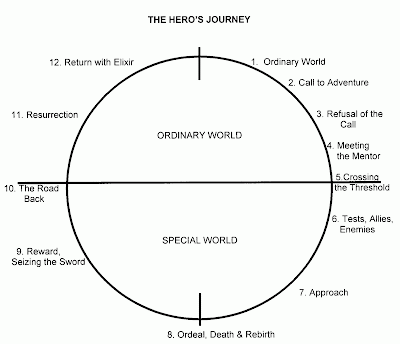
1. The ordinary world is where we begin, but in this life there is an unspoken imbalance, the suppressed niggle of incompleteness.

2. The call to adventure comes when the balance is finally tipped.  Something's wrong, the hero needs to act.

3. But instead there is refusal of the call.  Who comes quietly when they really have to leave their comfort zone, and when sacrifice is finally a present possibility?

4. Meeting with the mentor provides the required kick and equipping for the adventure.  But..

5. Crossing the threshold requires the hero to overcome a guardian, by absorbing and redirecting their power the hero enters a special world of new rules and powers.

6. The special world has both allies and enemies to be identified, and challenges that test the hero's true character.  The stakes keep rising as the journey goes on.

7. But even this special world has an innermost cave, where the hero must venture to reach their goal.  This is the approach.

8. And in the deep dark of the innermost cave the hero finally undergoes the ordeal of sacrifice, dealing with death itself, but finding a rebirth.

9. And the ordeal wins them the opportunity to seize the sword, grab the prize and reflect on their rebirth from death itself.

10. But there is a greater cause still at steak, the prize must be taken home, so the hero must begin along the road back.

11. The battle isn't done, however.  The greatest confrontation takes place in Resurrection, where the final victory is sealed and the trouble overcome.

12. Finally the hero can return with the elixir to the ordinary world.  Bringing a gift of life and revelation and the fruit of transformation.

Surely the language, the wise truth, the blatant Jesus-ness has struck you?!  Sacrifice and suffering, death and rebirth, the elixir of life..   It is The Story.  God's Story.  Creation's Story as His subject.  Jesus's story as God in Matter and as our model, our leader, our example, our Way, our Reality, our Life.

Our story.  As we follow.

In fact it is played out like some fractal form in the realm of spirit.  Through ages, generations, lifetimes and moments it is played out as the journey of transformation.  Each lesson and adventure is woven of these incidents.


What does this mean?

1)  The Hero's Journey is all about transformation; God has changed.  Unchangeable, yes, but free to change- of course.  And He has chosen to.  His character remains, but now there is flesh on the Throne and humanity in the Trinity.  God has changed in order to regain us and we are called to follow.

2)  Our identity grows from our willingness to go on the adventure of engaging with our Origin and Destiny.  Life in contact with God is our Special World, where the very Life Force, the Essential Spark meets with us, flows through us and resides in us.  He makes us and remakes us.  He breathes life.  He Names us and He Chooses us.  A Hero is Chosen.  You are a chosen hero, called on a dangerous adventure of transformation in communion with The Maker. 

3)  Our purpose flows from the Journey of the World.  God's inevitable plan is that All Things will be transformed and made New.  Our purpose, our Road Back is to excercise this transformation in our world.

4)  Of course, this gives us insight into the practical things.  The Journey tells us that even the best heralded call to adventure will typically be refused, and the mentor is needed to catalyse a decision to act.  When we're Called the most normal and natural response is to deny it and carry on.  But how many mentors are involved in really early discipleship; before any decision..?  What on earth do we expect after people get baptised..?  Tests?  Allies?  Enemies?  They are all to be expected on entering the Special World.

But now to my question from the beginning;

Where are we now?

What is the context to "unanswered" prayer?  Why, when we believe God is all good and all powerful, and some things are just good, like healing and finding and loving?  What's the back story to this world around us; the horrific sick distortion, hatred and hurt and the miraculous radical uncompromising unbounded intricate and elaborate action of God seemingly randomly distributed and in such close proximity?

I believe that we are on the Road Back.  So, a little more flesh on the bones of this leg of the journey:

The road back follows seizing the swordThat's the moment when you realise you are reborn, you've made it, come through the ordeal and now you sit, fresh and unburdened, on the edge of the alter, a new creation with the prize in your grasp.  You know that moment in the film, when the hero has apparently been overcome by their arch enemy but now, somehow, miraculously after all was lost, they have returned from the brink, or maybe even beyond it.  But now they realise that the job isn't finished, they must get back, rescue the captives, escape the enemy base, difuse the bomb, save the day or save the world.  Then comes the chase.  The crippled but maddened enemy lashes out in a final attack, often more vicious than before.  Now they are really threatened, their empire  crumbling around them already. They make one last ditch attempt on the life of the hero and their now hopeless ambitions.  The hero runs to win the Greater Cause, the enemy pursues. 

On the road back, the hero has to throw everything they've got back at the enemy simply to buy time to make good.  In myths and fairytales, the gifts of the special world often transform magically into great obstacles to the enemy as the hero casts everything down in the chase.  The Road Back follows the great crisis of the story, but it is only the final ascent to the climax to follow; the greatest conflict and the great refining of the hero.


So what?

This is the bit I find the hardest - conclusions.  Here's my start.  

1)  We're on the road back, not the home straight.  The crisis of redemption has taken place, but the climax is to come, followed by the final fruit.  It isn't an easy ride from Easter to New Heaven and Earth.  His Kingdom breaks in but this is not the final conversion.

2)  On the road back, a prize stolen is followed by fierce retribution, a prize divinely bestowed is accompanied by provision.  Our reconciliation and redemption are both; we have been snatched from death and decay, and through Jesus' sacrifice the Father joyfully calls us His very own.  What can we expect but ferocious attack and abundant treasure.  The present is the most extreme, intense time point in all history, and the intensity increases.  Sparks are flying as Love and sin clash, and we occupy the threshold.

3)  God has chosen the Heroic Way.  He will transform the world but through His own transformation and sacrifice.  He will not overpower Creation, but instead He has become it.
His road back, His re-commission to the cause of Creation, is to make His Church His bride, in unity with His Spirit; bone of His bones and flesh of His flesh.

God is love.  And with Him it is always personal.  His work in the world starts in us, our own transformation comes first.  We are called to die to our ego and follow Him before anything else.  His priority is the person.  But then we follow His way to join in His transformation of the World; through Love, the sacrifice of self for the thriving of another, we will invert the order of this plane.

It is confoundingly powerful and offensive, love and sacrifice subvert the occupying empire.  We are rebels of the revolution, the exiles reclaiming the land.  We are insighters of civil rest.  We can expect marvelous things but the base condition is still the mess.  We deal with life and death.  We draw from the deep.

And nothing sacrificed is wasted. 

His Kingdom will burst into this horribly wrenched world where we go.  Expect suffering, expect joy.  Expect brokenness and expect healing.  Expect to loose and expect to win.  Expect death, expect life, expect Resurrection.  Expect the whole world to be turned upside down and inside out on itself.  Expect to be transformed.  Expect change.

Watch the seed that falls to the ground and sprouts fresh new life.  Watch the tiny sparrows, when their heads rest in the dust it is counted.  Watch out because this world was created good and the Good Creator has launched His rescue mission. 

We are God's very children, called to know Him and sent out to do what He does.  He is the Hero of the World, and He is our Way.  Our reality, and our Life!

Monday, 25 July 2011

Step To

On that Friday I met with a mentor.  I was fortunate that he came bearing a gift; a key aspect of the mentor's part.  The gift was an insight; he declared me a theologian. 

Now I thought theology was what we called it when we tried to understand God; I considered it the study of the world's view of God.  But he put it differently, he described it as the exercise of seeing the world as God does; the pursuit of God's view of the world.

Another thing; reality.  God's view is the real reality.  He is the Definitive, the Absolute Prototype of being.  He gives meaning to everything, and everything finds its reference and context in Him.  In that image, part of the human role is to name, to identify, and to declare purpose and consequence, pattern and rule in our observation and participation in our world.  We are creation's voice to its creator, and the hands of God to the crops and creatures.  Yet we live in filtered realities.  Our perception is skewed and damped, our range restricted.  It is almost certain that we each live in a false reality, yet freedom lies in the light.

Now how God sees things has also risen out of conversation that I've shared over this topic of the seemingly conflicting rule of God and mess of the world.  If Jesus is the visible image of this invisible God, and He showed unrestrained hostility toward sickness, shame and death, then how is it that sometimes healing doesn't come and death perseveres?  How is it that God is over, in and through it all and the sickness persists?

I can accept the view of the free world, relinquished control and the restrained hand of judgement.  But Love cannot help but intervene.  God cannot help but hear.  I see miracles and I see the divine initiative.  The outworking is utterly personal.  There are no rules, only relationship.  But here's my crux.  I can't work out what His priorities are; the values applied to the decision to act.  I get stuck on the Barney story, which somehow becomes my ensign for all the suffering and disappointment I see.

God is in all, and He feels the pain and dwells in the heart of the victim.  He is the God who Hears, the God who Sees.  Is He the Great Overseer or the Abiding Witness?  What is the default condition of this age?  He refuses to destroy an evil city for the sake of a few good men within.  But I see the action of unconstrained love in Jesus. 

So where are we now?  What is the present reality?  I think we're on the Road Back, but what are the rules, and how is it with the residual enemy?  Finding the realty should resolve the conflicting projections.  Then there is freedom, and in Reality is life.

Tuesday, 12 July 2011

Entry No. 1

For now, this blog is for the writing, not the reading (except by me).

It is part of my journey into song writing and, for want of a better word, theology.  For some time, I have sensed God's permission and call to write songs.  I've started.  But more recently I've felt inspired to push for a deeper realisation of God in His Creation.  For me, the reality has to be greater.  God is utterly universal and fundamental.  The very fabric of creation; whatever essential substrate it is that we propagate through, is woven with His song and purpose.  The universe inevitably echos His beauty, which reemerges from even the most horrific distortion.  It revolves about Christ as it's origin, the focus of all things, all things.  And there is the Re-Creation, the renewal, the restoration, reconciliation of it all.

If His Gospel is woven into the very ether, then it must be an essential thing.  Not complicated or the stuff of reason, but simple mystery; beautiful, awful and utterly personal.  With God, it's always personal.  He is Love.  He is also wild, unconstrained by rules or principles.  He is fearsome.

I have been struck by the Hero's Journey.  If Joseph Campbell has extracted the common spirit from the legends, myths and stories of many cultures, this is likely to be riddled with the revelation of God in the hearts of men; Jesus Christ.

In essence, the Journey is transformation.  And that is the journey led by Jesus.  The incarnation was a transformational act in the very being of THE LORD. The crucifixion was a transformational act in the spiritual realm of creation.

We are called to follow; to enter the special world of relationship with our God (the Life Force) and be transformed.  It inevitably takes us to death, but the prize is transcendent life.  That's our identity.  Our purpose; to join in the transformation of the world.  To partake in the re-creation - we call it the Kingdom.  It is the same transformation we undergo in our beings, but we minister it as priests to creation, and the Image-Bearers who suffer under it's current distorted turbulence.

Recent events have served me with a call to adventure.  In the context of this strong desire to write songs which speak of deep truth, and my efforts to allow my faith to be formed into a more Christ-like, incarnational, physical acknowledgement of God in all, I have suddenly been disappointed and confused.  My view of God was broadening; I wasn't under the impression that bad and evil didn't pervade, but I did believe that anything was possible, and that Jesus, who has the will and the power to work in all situations, was available in all.  This sense was rocked by the events that culminated in the death of our cat, Barney.

First, a reminder of me and cats.  Since my earliest days I have been an animal lover, and this was most clearly exemplified in my love of our pet cats.  For most of my childhood, my cat was a very close companion, and as an adult I still consider the pet cat to be a full member of the family.

Just about a month ago, Barney our one and a half year old cat, went missing for a few days.  We were vey concerned as he was a creature of habit and we knew something must be wrong.  We searched literally day and night, we flyered the local area and put up posters.  We phoned vets and animal charities.  We followed up calls, we had an announcement on the radio.  We left the 99, stopped living and searched for Barney.  We prayed.  Our church friends prayed.  Our families prayed.  We doubt that a domestic moggy has ever had so many requests made to the almighty on their behalf!  And we trusted.  Our searching was not out of doubting God, but rather to live out the demonstration that the spiritual and physical are united.  The miraculous and the laws of physics go hand in hand as they are both ordained by God.  There is no conflict as both honour God, and He honours both.  We were concerned, but we felt peace.

Four days later we received a phone call.  Barney had just been run over and was dead.  I cycled from work to collect his body, it must have been only an hour or so after he'd died that I got there- the home owner had one of our flyers so had called us almost immediately.

The part that hit us was that he had been run over on his way home.  We had worked out from the reports and responses we'd had from neighbours, that Barney had most likely ventured off our housing development and into the nearby allotments for the first time.  He was probably either lost or trapped in a shed or greenhouse.  I had searched the allotment a number of times and put up posters.  It seems that we were right, as Barney was hit as he crossed the road back from the allotment to our estate.

He had survived the ordeal.  He was on his way home.  And then it was all ended in a moment.

And our question was: why?

We know many of the arguments or explanations used for suffering in the world (by the way I realise this is nothing- the insane horror of our world is not aptly represented by the death of a pet cat).  But none of them seem to fit..  Sure, the driver had free will to drive fast or not spot a cat or not swerve or brake or whatever.  But Barney wasn't human; there's no principle of free will that has to be upheld to prevent a cat from waiting a few more seconds to cross..  Or maybe we've dragged an innocent cat into our fight and he's taken a hit for our faith, maybe he's now a Christian cat..  So why not whisper a word of warning to him.  Maybe we're taking it all to seriously, but if that's the case why not knock out a small favour; it means a lot to us after all and we've got loads of people praying.

I could go on.  The truth is that God has spoken on the matter.  Rosie and I have both felt Him say that actually Barney means more to Him than us, and that God feels the hurt of the event even more intensely.  God values Barney more than we do, and he feels the pain of the sick irony more strongly too.

And so my call to adventure.  The scope of my search has widened to try to make some kind of sense of the terrible wrenching pain of this world, as well as discover God saturating it all through the depths and heights.  I have been unsettled, disturbed, and I can't go back.

So how to go forward?  I need to forge time for writing; expressing; praying and worshiping.  I will let God have His portion.  Of course His portion is it all, but I shall give it intentional expression - manifestation in time and attention.

But I know that this Jesus has be be experienced.  And He demands action.  So I find myself searching the things I've felt called to in the last few years.  In a list:

My Family (wife, toddling daughter and unborn daughter)
Sex & Marriage (theology of..!)
Slavery (ending of)
Fairtrade (spreading of, especially at my workplace)
Music (song writing, performing)
Worship Leading
Wanting to speak in Tongues (complicated)

Where next, who knows?

I've received the Call.  In my heart I deny it as I still seem to hold Barney's death against God, emotionally if not consciously.  I need His help on this.  Next; meeting with the mentor, which looks well lined up for Friday morning.

And that's where I am.

Ends.